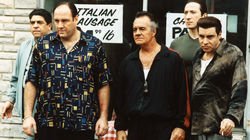
Junior feels the restrictions of his house arrest acutely, while Tony starts putting in hours at his actual job to allay FBI suspicions.
House Arrest (S02E11) aired March 26, 2000. Written by Terence Winter and directed by Tim Van Patten, the episode runs a parallel structure: Junior is under literal house arrest following his arraignment, while Tony attempts a self-imposed version of the same constraint on the advice of his lawyers.
Plot
Junior Soprano is confined to his home on house arrest, awaiting trial on racketeering charges. The confinement is killing him. He has no one to talk to, nothing to do, and the days stretch. He reconnects with an old friend from his past, and for a while the company helps. But the house arrest is not just physical. It has stripped away whatever status and routine organized life had given him, and he becomes irritable and depressed in ways that read as more serious than boredom.
Tony's situation is different but the episode draws the comparison deliberately. Neil Mink, Tony's lawyer, has been pressing him to distance himself visibly from mob activity. The FBI is watching. Mink's advice is to spend time at Barone Sanitation, the legitimate waste management company Tony has an interest in, and look like a businessman. Tony hates it. The office, the paperwork, the employees who look at him without fear - all of it makes him restless and anxious in a way that a sit-down with Richie Aprile never would.
Tony's panic attacks return during this period. In session with Dr. Melfi, he describes the feeling of dread that comes over him at the sanitation office. Melfi points toward the underlying issue: the violence and unpredictability of Tony's criminal life are not incidental stressors. They are, in some perverse way, what keeps his anxiety manageable. The legitimate world, with its boredom and accountability, removes the adrenaline that has become necessary to his functioning.
Richie Aprile continues to be a problem on the periphery of the episode. His resentment of Tony's authority has been building all season. Janice has gotten close to Richie, which Tony finds distasteful and strategically inconvenient. Richie wants more and is not patient about it.
The episode ends with Tony back at the Bada Bing. The house arrest experiment failed. He could not sustain a legitimate front because the legitimate world offered him nothing he actually wanted. Junior's house arrest is enforced by the state; Tony's would have had to be self-imposed, and he discovered he lacks the will for it.
Credits
Written by Terence Winter, who was already responsible for some of the show's sharpest character work in this period. Directed by Tim Van Patten. James Gandolfini as Tony, Dominic Chianese as Junior, Lorraine Bracco as Dr. Melfi, David Proval as Richie Aprile, and Aida Turturro as Janice all appear.
Music
The episode's use of music is calibrated around the flatness of Tony's legitimate-work scenes, which feel deliberately scored down compared to the energy of mob settings. Any streaming version may carry licensed track differences from the original broadcast print.
Analysis
The title operates on two levels simultaneously, which is characteristic of the show's best episode naming. Junior's house arrest is the law's version of confinement. Tony's attempted self-confinement to legitimate activity is voluntary but ultimately impossible to maintain. The episode is making an argument that Tony is not capable of reform because the very thing that produces his anxiety is also the thing that keeps it in check. The tension between those two facts is what makes him who he is.
Melfi's analysis - that Tony's legitimate-world anxiety is downstream of his removal from the violence and excitement of mob life - is not presented as a clinical curiosity. It is presented as a structural fact about who Tony Soprano is. The show does not treat this as tragic in the sentimental sense. It treats it as accurate.
The parallel between Junior and Tony holds throughout, and then diverges at the end. Junior endures his confinement because he has no choice. Tony walks back into the Bada Bing because he has one and makes it. That difference is the episode's point.
For the season arc see the season two guide. The Richie Aprile situation that runs through the background here accelerates significantly in the following episodes.