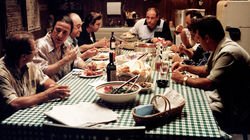
S03E01 - aired 2001-03-04

Mr. Ruggerio's Neighborhood

Season 3 episode guide - plot, credits, music, and analysis.

Plot

The season opener finds Tony Soprano in a state of high alert, waking up from a dream where he is being chased by a giant spider that transforms into his father, Johnny Boy. The imagery immediately signals the deep-seated anxiety regarding paternal authority and fear of abandonment that defines Tony's psyche. After a tense therapy session with Dr. Jennifer Melfi, where they dissect the dream and Tony's recent irritability, Tony heads to work at D'Angelo's restaurant. There, he faces a crisis of confidence when his partner, Paddy O'Rourke, is fired by Carmela for stealing money meant for the kids' college fund. Tony defends Paddy against Carmela's fury, revealing a complex dynamic where he feels responsible for Paddy's survival but also recognizes the financial reality that has forced Carmela's hand. The episode quickly shifts gears to the broader criminal underworld as Tony visits Mr. Ruggerio, his longtime friend and accountant. Ruggerio is visibly shaken, having just learned from the FBI that a wiretap is active on his phone calls. This development throws the entire organization into chaos, forcing Tony and his crew to exercise extreme caution with every conversation. The tension escalates during a meeting with Gennaro "Genny" Caccetta, who is being interrogated by FBI agents about a murder involving a young girl. Tony must navigate this delicate situation without tipping off the authorities or endangering his own position, highlighting the fragility of their illicit empire in the face of federal investigation. Meanwhile, Junior Soprano struggles with his own demons, specifically his fear of death and a recurring nightmare about being buried alive. He seeks out Dr. Melfi for guidance, though his relationship with her is strained by his history of therapy resistance. The episode also introduces new characters to the family fold, including Tony's mother Livia, who arrives from New Jersey, bringing with her a distinct brand of manipulative influence that will become a central conflict throughout the series. Her presence causes friction within the household, particularly with Carmela, setting the stage for the generational clashes to come. In a subplot that foreshadows future betrayals, Tony discusses business matters with Paulie Gualtieri and Silvio Dante. The atmosphere at D'Angelo's is thick with paranoia as they try to maintain normalcy while under the microscope of law enforcement. The episode concludes with a somber moment for Tony, who reflects on the weight of his leadership and the constant threat hanging over his head, setting a tone of impending doom that permeates the rest of Season 3.

Credits

James Gandolfini as Tony Soprano Lorraine Bracco as Dr. Jennifer Melfi Edie Falco as Carmela Soprano Michael Imperioli as Christopher Moltisanti Dominic Chianese as Corrado 'Junior' Soprano Steven Van Zandt as Silvio Dante Jamie-Lynn Sigler as Jamie-Lynn "Meemaw" Soprano Tony Sirico as Paulie Gualtieri Robert Iler as A.J. Soprano Brian McNamara as Brad "Baz" D'Angelo Anthony LaPaglia as Dr. Melfi's Patient (Gennaro Caccetta) Drea de Matteo as Adriana La Cerva Neil Giuntoli as Ralphie Cifaretto Timothy V.tu as Junior Soprano's Therapist Frank Vincent as Tony's Lawyer

Music

"Theme from The Sopranos" - Randy Edelman "New York, New York" - Frank Sinatra (Radio Song) "Fly Me to the Moon" - Bobby Darin (Radio Song) "I Only Have Eyes for You" - Les Paul and Mary Ford (Radio Song) "Blue Moon" - The Four Freshmen (Radio Song) "Summertime" - Billie Holiday (Radio Song) "La Vie en Rose" - Edith Piaf (Radio Song) "My Funny Valentine" - Chet Baker (Radio Song) "Unchained Melody" - The Righteous Brothers (Radio Song) "All of Me" - Tony Bennett (Radio Song) "Cheek to Cheek" - Fred Astaire and Ginger Rogers (Radio Song) "Star Dust" - Bing Crosby (Radio Song) "Night and Day" - Frank Sinatra (Radio Song) "Autumn in New York" - Ella Fitzgerald (Radio Song) "Fly Me to the Moon" - Tony Bennett (Radio Song)

Analysis

Mr. Ruggerio's Neighborhood stands as a definitive turning point for the series, effectively moving the show from a procedural crime drama into a psychological thriller wrapped in mafia mythology. The title itself is a direct reference to the pervasive paranoia that now defines Tony's existence; the neighborhood is no longer just a place he lives, but a minefield of surveillance where every interaction could be recorded and used against him. The activation of the wiretap on Mr. Ruggerio serves as the catalyst for this new era, forcing the organization to shrink its operations and retreat into a defensive posture. It is a masterclass in tension, showing how a single piece of technology can dismantle an entire criminal enterprise's sense of security. The dream sequence at the beginning of the episode is crucial for understanding Tony's internal landscape. The spider transforming into his father suggests that Tony's fears are not just about external threats like the FBI, but also about the ghost of Johnny Boy Soprano still haunting him. This fear of paternal judgment and the desire to break free from it runs parallel to his fear of being caught. Dr. Melfi's session highlights this duality, as she points out that Tony is trying to control his life by controlling his environment, specifically by avoiding vulnerability. However, the wiretap forces him to be vulnerable in a very public way, stripping away his ability to manipulate conversations through subtext. The introduction of Livia Soprano marks another significant shift. Her arrival brings a new dynamic to the family, one that challenges Tony's authority and complicates his relationship with his mother. It is interesting to see how quickly she asserts dominance over Carmela, creating a power struggle within the household that mirrors the external political battles Tony is fighting. This sets up a long-term arc where Tony will have to balance his loyalty to his family unit against the toxic influence of his mother, a theme that will resonate throughout the season. The firing of Paddy O'Rourke adds a layer of domestic realism to the show's criminal elements. It shows that even in the world of mobsters, financial responsibility and family obligations are non-negotiable. Carmela's reaction is not just anger